
Melania Trump's Missing Years: a Gap in the Record

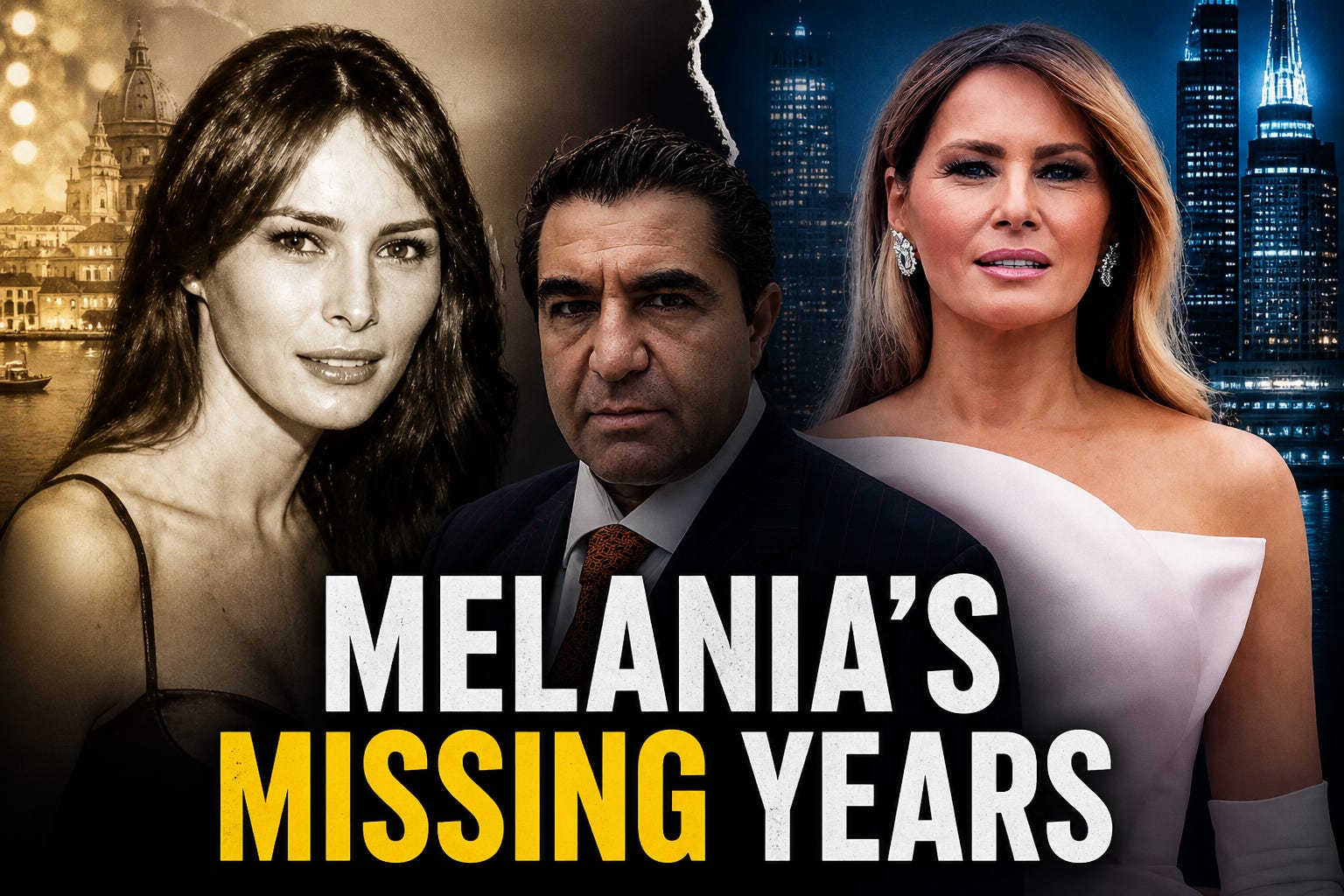
In most public biographies of Melania Trump, the early modelling years are presented as relatively straightforward. A progression from Slovenia to Italy, then into Milan’s fashion industry, and eventually to New York where her career intersects with Donald Trump.
However, when you look closely at the available documentation from the mid-to-late 1990s, there are periods where the record becomes significantly thinner. Photographic evidence is limited, agency listings are inconsistent, and accounts from individuals working in the same environment do not always align on timing or frequency of appearances.
What emerges is less a continuous timeline, and more a series of confirmed points separated by intervals where activity is less clearly documented.
A Resurfaced Image From the Early Years
Adding to renewed public interest in this period is a resurfaced piece of footage showing Melania Trump during an early public appearance in New York, wearing a pink fringe dress while twirling for the camera alongside Donald Trump. The clip has circulated widely in recent weeks after remaining largely absent from mainstream compilations of their early relationship.
While visually brief, the footage is often cited in discussions around the early phase of their public visibility together, capturing a moment that predates the formal political narrative that would later define both figures.
For some, it serves as a visual anchor point in a timeline that otherwise remains fragmented across different accounts, recollections, and reporting cycles.
To watch this clip, and a full breakdown of this article, YouTube video embedded below:
Early Modeling Traces in Italy
One of the earliest identifiable points in Melania Knauss’s modelling career appears in Italy, associated with a small fashion event at Cinecittà Studios in Rome.
At the time, she is described as part of a group of emerging models being assessed by industry figures operating between editorial publishing and fashion scouting. The event itself has been described through retrospective commentary from a judging panel member who was interviewed years later, a figure also noted in the coverage for his personal collection of bas-reliefs depicting Mussolini-era iconography, a detail that has circulated in discussions around the cultural framing of that period in Italian media.
He shows a page from a publication with “Melania Knauss” as the header.
This moment is often framed as the beginning of her European modelling trajectory. Beyond this, however, independently verifiable runway records from the same period are limited, and peer recollections vary in terms of how frequently she appeared in shows or campaigns.
Milan and Agency Period
Following the Rome appearance, she is said to have moved into Milan’s modelling circuit, which at the time was one of the most competitive fashion environments in Europe.
In parallel accounts from contemporaries within the modeling industry, the picture becomes less consolidated. One such perspective is attributed to Samantha de Grenet, an Italian actress and television personality, who was referenced in interviews reflecting on the modeling environment of that time. Her account describes a lack of clear memory of Melania’s presence across the shows she personally worked on during that same period, despite being connected to the same agency network. She recalls hearing that Melania was associated with Riccardo Gay’s agency for roughly a year and a half, while also noting uncertainty around how frequently she actually appeared on runways or in booked work.
This divergence is where the timeline begins to lose its uniformity. It is within this context that Paolo Zampolli is later introduced in multiple accounts, with references to him “discovering” Melania during this early phase. What that term actually signifies varies depending on the source, and is often left undefined within the reporting itself.
The 1995–1998 Transition Period
Between 1995 and 1998, there remains a widely discussed gap in the publicly documented timeline of Melania Trump’s life and career. This period is frequently referenced in commentary and retrospective reporting as one of the least clearly documented phases prior to her relocation to New York.
Different accounts have emerged regarding when the transition to the United States actually occurred. Donald Trump and Melania Trump have publicly stated that their first meeting took place in 1998. However, alternative witness accounts and earlier reporting have suggested an earlier meeting date in 1995. That discrepancy was also previously referenced in a 2016 Daily Mail article, which was later edited and formally retracted following legal dispute and subsequent apology, with the publication stating that certain claims could not be substantiated by available evidence.
Rather than resolving the timeline, the retraction effectively closed one version of the narrative while leaving the underlying gap in chronology still widely discussed in later commentary.
Arrival in New York and Competing Narratives
When Melania Trump’s arrival in New York is described in modeling histories, it is typically positioned as the point at which her career becomes more clearly documented through commercial work and agency representation. Yet even this transition is shaped by competing narratives about timing and sequence, particularly when compared against earlier European activity.
The unresolved difference between a 1995 versus 1998 meeting Donald Trump timeline has become a recurring point of reference in discussions about how her early professional and personal trajectory intersected with New York’s fashion and media environment. These inconsistencies have been referenced across both archived reporting and later commentary, though they remain disputed and unverified as definitive fact.
Closing Note
What emerges from this period is less a single linear biography, and more a collection of overlapping fragments—interviews, recollections, archived reporting, and resurfaced media—each contributing to a timeline that remains partially unverified in its early stages.
As with much of this broader narrative, the focus continues to return to the same unresolved window between 1995 and 1998, where documentation is limited and later accounts diverge in important ways.
That is the space where the story continues to be re-examined.